- The 8-inch wall peaked at 140°F while its companion cylinders peaked at 120°F, and were 39°F apart by midnight
- At 24 hours the wall had banked 1.37x the cylinders’ maturity: 93.4 °F-days (4,402 psi) vs 68.1 °F-days (3,865 psi)
- The wall passed the 1,500 psi stripping threshold about 5.5 hours after placement; the first cylinder that could prove it broke at 24 hours, and the forms came off at 48
- That is roughly 42 hours of form time and cycle time the data had already released, on a single wall
- A verification cylinder not used to build the calibration curve predicted both of its breaks within 0.7%
- For testing firms, maturity adds a recurring monitoring service line; acceptance testing under ACI 318 / ACI 350 is untouched
Introduction
On the UTRWD NE Regional Water Reclamation System Expansion for Doe Branch, Sensytec ran a SensyCast field demonstration with HVJ Associates, the project’s construction materials testing firm, on the last wall pour of the job: the outfall wall. Archer-Western Contractors built the work; Bar Constructors placed the concrete. The question on the table was simple: how far apart are the structure and the cylinders that represent it?
The Challenge
A cylinder and the structure do not cure the same way. The cylinder is small, sits in a field box, and stays close to air temperature. The structure is thick, holds on to its own hydration heat, and can run far hotter. Yet every scheduling decision on a job, stripping forms, backfilling, loading, is about the structure, and most jobs deal with the difference by waiting longer than they need to. ASTM C1074 deals with it using data: the temperature history inside the element, and a strength curve calibrated to the mix being poured.
The Demonstration
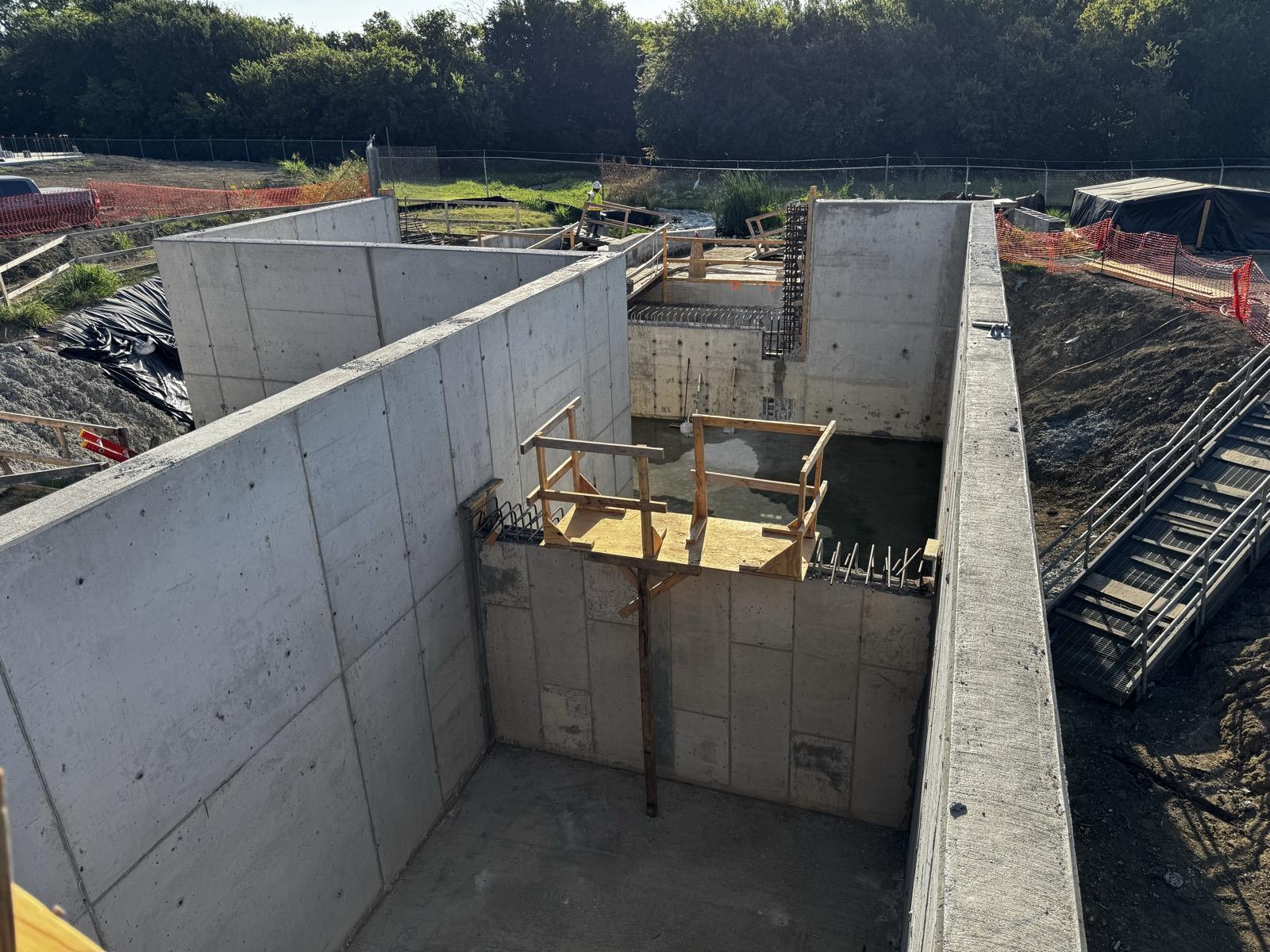
The outfall wall is about 8 inches thick and 14 to 16 feet tall, the thinnest section on the job. The mix was a Class A 7.0-sack design, w/cm 0.41, 25% pozzolan, Type IL(12) cement, specified at 1,500 psi to strip forms and 4,500 psi at 28 days. Concrete went in on July 28, 2026, between 07:45 and 08:16 AM at 89 to 95°F. SensyCast probes were tied into the rebar cage before the form was closed: two in the wall, two in companion cylinders cast off the same truck. Both instrumented cylinders sat in the field box with the acceptance cylinders, so every break could be matched to the maturity that cylinder actually experienced.
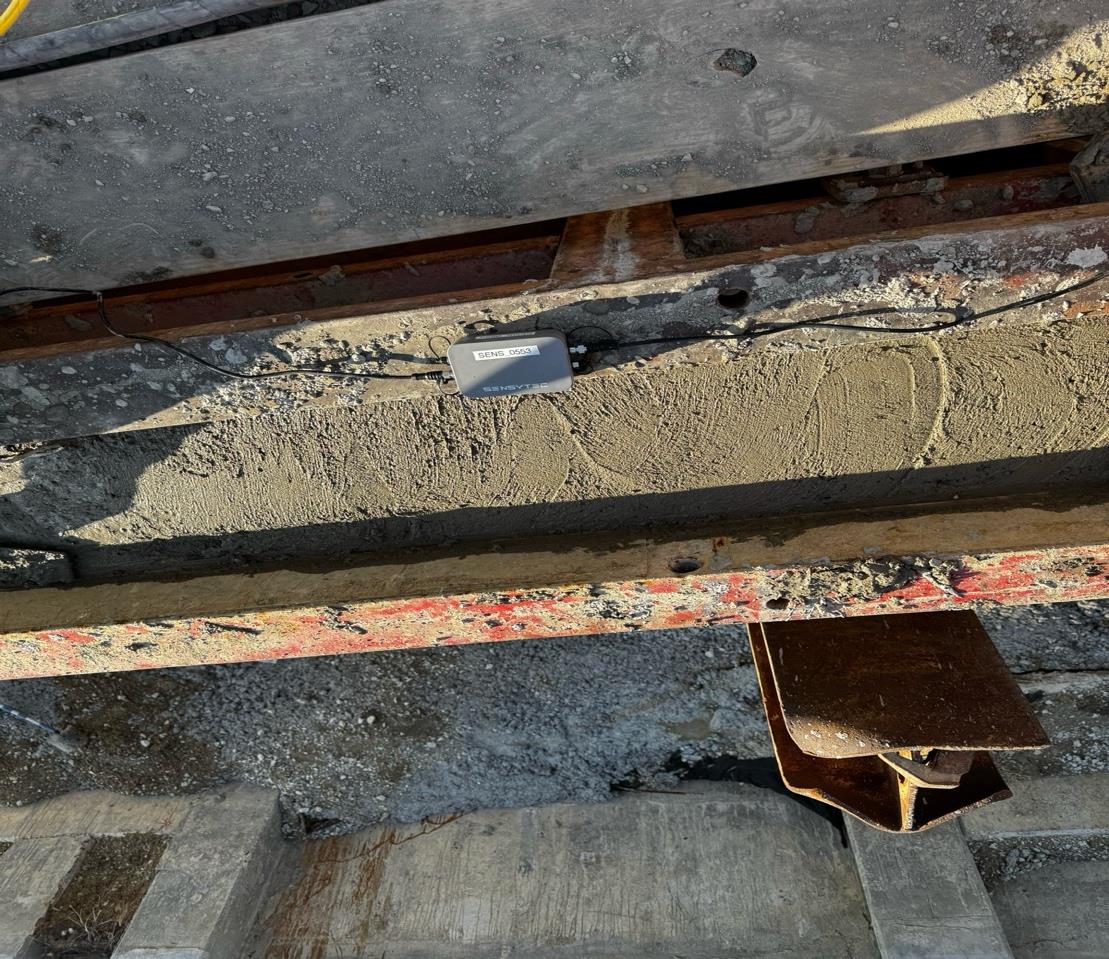
Logger SENS_0553 on the form rail. Four channels per logger; data reaches SensyHub without walking the site.
What the Data Showed
Over 27 hours the wall peaked at 140°F while the cylinders beside it peaked at 120°F. Overnight the cylinders shed their heat to ambient while the wall held on to its own; by midnight they were 39°F apart. Because warm concrete reacts faster, the maturity curves never crossed back: at 24 hours the wall had banked 93.4 °F-days against the cylinders’ 68.1, 1.37x ahead. On the calibrated curve that put the wall at 4,402 psi when the cylinders stood at 3,865 psi.
Two probes in the wall, two in cylinders cast off the same truck and stored in the field box. The wall peaked at 140°F while the cylinders peaked at 120°F, and overnight the gap widened to 39°F as the cylinders shed heat to ambient.
The number that matters for schedule: on the calibrated curve the wall passed the 1,500 psi stripping threshold about 5.5 hours after placement, just before 2 PM on the day of the pour. The first cylinder that could have proven it was broken 24 hours after placement. The forms came off at 48 hours. That is the whole point of the demonstration: the wall was strong enough to strip before lunch on day one, and it stayed in its forms for another day and a half because the only accepted proof was still curing in a box.
On the calibrated curve the wall passed the 1,500 psi stripping threshold about 5.5 hours after placement. The first cylinder that could have proven it was broken at 24 hours, and the forms actually came off at 48 hours.
The calibration held up to checking: each cylinder’s crushed strength was paired with the maturity that same cylinder recorded, and a second instrumented cylinder that was not used to build the curve predicted both of its breaks within 0.7%.
What Those 42 Hours Cost
Forms standing on a finished wall are not mainly a rental bill. In a published engineering worked example for a rented steel gang forming operation, labor and crane time together came to about 73% of the cost while rental, freight and loss allowance were about 17%. Holding forms holds the crew and the crane that should be building the next pour.
| Form time released, this wall | 42.5 hours, about 1.8 days |
| Structural walls on the job | about 5 to 6 |
| Form time released across the job | roughly 9 to 11 days |
At the $9,500 per day our ROI calculator uses as its general-contractor default, that is about $16,800 on this wall and on the order of $84,000 to $101,000 across the structure. Only one wall was instrumented, so the rest is an extrapolation of the same pattern, and the rate is our default rather than this project's.
This wall was 8 inches thick, the thinnest section on the job, and it still ran 20°F hotter than its own cylinders. Thicker sections hold more hydration heat and pull further ahead, so the walls poured earlier likely had more time available, not less.
None of that is anyone's mistake. Until the maturity curve existed, the first admissible proof of strength was a cylinder break, and the practical window for that break was the next morning. The crew never had the option to strip at 5.5 hours, because the alternative was never measured. What waiting to strip forms actually costs works through the formwork economics, what ACI and FHWA permit, and how to price your own wait.
What It Means for Testing Firms
The first question every materials testing firm asks is “does this cut our cylinder work?” It does not: it moves the work earlier and adds to it. Acceptance is untouched: compliance still rests on standard-cured cylinders at the specified test age under ACI 318 and ACI 350. Every mix needs its own calibration first (15+ cylinders per ASTM C1074, plus early ages where release decisions get made), and C1074 asks for independent in-place checks before critical operations. What it opens up is a recurring service line, sensor supply, installation, monitoring, interpretation, and reporting, billed per project, per month, or per element, and a point of difference in a market that otherwise competes on unit price for commodity testing.
Conclusion
For the owner, maturity means schedule certainty and a documented engineering basis behind every early release decision. For the general contractor, it means stripping, backfilling, and loading on data instead of on the calendar. For the engineer of record, it means in-place strength where it matters plus a continuous temperature record on ACI 350 water-retaining work. One instrumented pour made the case for all three, and it put a number on the cost of waiting: about 42 hours of form time on one wall.
Frequently Asked Questions
Why did the wall cure faster than its own cylinders?
The 8-inch wall held on to its own hydration heat and peaked at 140°F, while the companion cylinders in the field box peaked at 120°F and shed heat to ambient overnight. Warm concrete reacts faster, so by 24 hours the wall had banked 1.37x the cylinders’ maturity.
How much earlier could the forms have come off?
On the calibrated curve the wall passed the 1,500 psi stripping threshold about 5.5 hours after placement. The forms came off at 48 hours, so roughly 42 hours of form time was available on that one wall. The crew was not being over-cautious; until the maturity curve existed, the first admissible proof was a cylinder break at 24 hours.
Does the maturity method replace acceptance cylinders?
No. Acceptance is untouched: compliance still rests on standard-cured cylinders at the specified test age under ACI 318 and ACI 350. ASTM C1074 estimates in-place strength for scheduling decisions; it does not certify compliance.
How accurate was the calibrated maturity curve?
A second instrumented cylinder that was not used to build the curve predicted both of its breaks within 0.7%, every break matched to the maturity that same cylinder actually experienced.
What does maturity monitoring mean for a materials testing firm?
It does not cut cylinder work; it moves the work earlier and adds to it: calibration sets, early-age breaks, in-place checks, and a recurring monitoring and reporting service line that moves the firm from reporting numbers to advising on schedule decisions.