A concrete sensor is an embedded device that measures temperature and electrical resistivity from inside a concrete pour and transmits the data to a phone, gateway, or cloud platform — used to estimate in-place strength via the ASTM C1074 maturity method, monitor curing temperature, and document quality control without breaking cylinders.
- Concrete sensors measure properties from inside the pour — most commonly temperature and electrical resistivity — and stream the data to a phone, gateway, or cloud platform.
- ASTM C1074 (maturity method) and AASHTO T-358 (surface resistivity) are the foundational standards. Modern sensors implement both.
- Sensors that measure both temperature and resistivity provide two independent strength signals; temperature-only sensors give only the maturity signal.
- Properly calibrated sensors correlate with cylinder break tests at 95–99% accuracy. They replace many strength-decision breaks but periodic acceptance cylinders are still required by most codes.
- Choose by mission: single-use Bluetooth for slab work, reusable long-range for precast plants, multi-depth for mass pours and bridge decks.
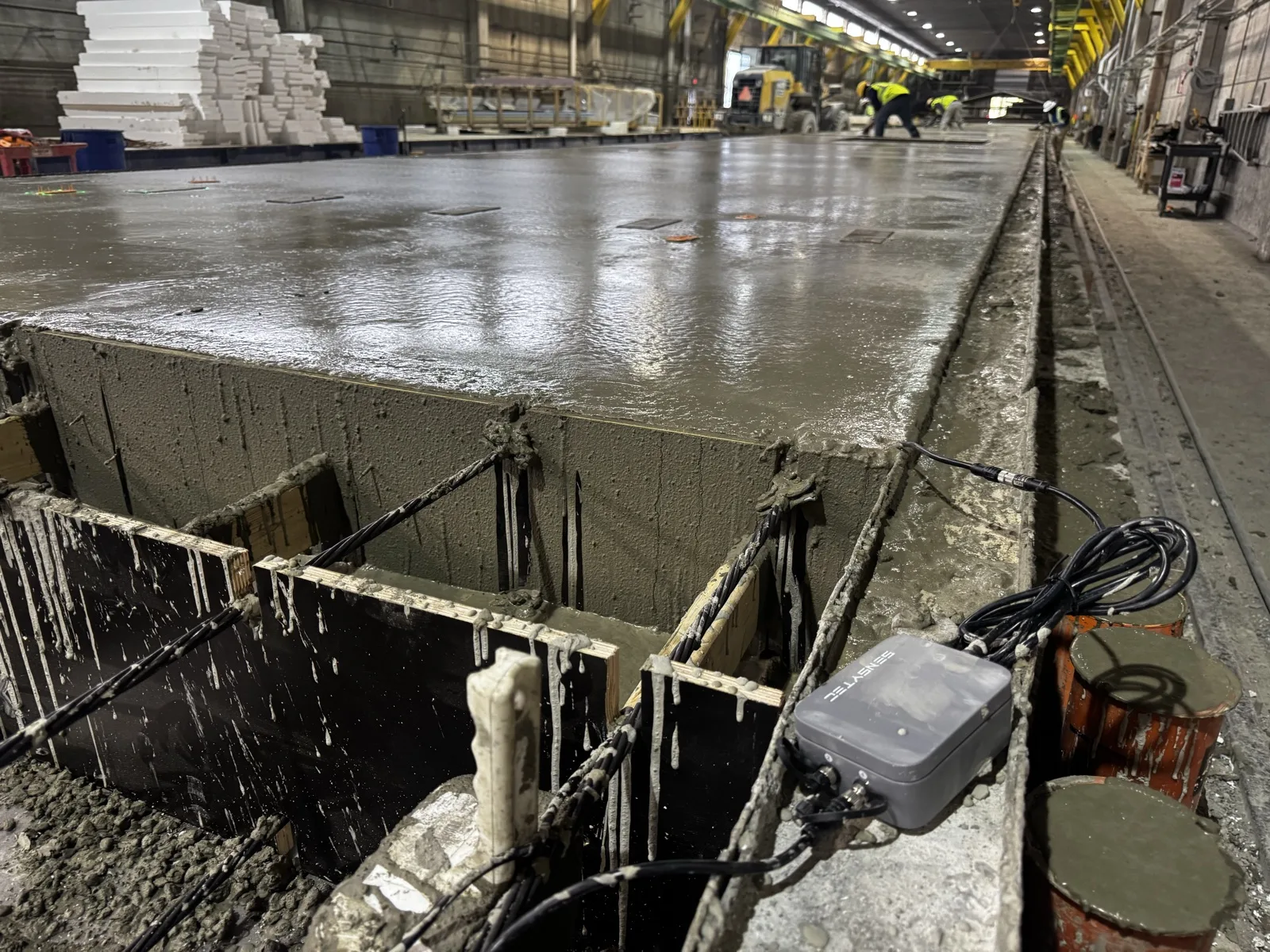
A wireless concrete sensor tied to the rebar cage before placement. The sensor reads continuously through the entire cure.
What Is a Concrete Sensor?
A concrete sensor is an embedded device that measures one or more physical properties of concrete from inside the pour. The most common measurements are temperature (for the maturity method and thermal control) and electrical resistivity (for cure progress and durability). The sensor transmits its readings to a phone, a fixed gateway, or a cloud platform, allowing engineers and QC managers to make decisions based on real, in-place data instead of estimates from companion cylinders cured nearby.
The category includes a range of devices that differ widely in capability: a single-use embedded probe with Bluetooth, a multi-year reusable sensor with long-range wireless, a wired thermocouple data logger with several channels, and surface-mounted devices that read only the formwork temperature. The right device depends on the application, the duration of monitoring, and the kind of decisions the data is supposed to support.
How Concrete Sensors Work
Temperature and the maturity method
Cement hydration is exothermic and temperature-dependent. The rate of strength gain in concrete is a function of how much heat the cement has released and at what temperature. The ASTM C1074 maturity method formalizes this principle. The method integrates the temperature-time history of the in-place concrete to compute a maturity index, then applies a calibration curve — established once for each mix design from companion cylinders — to estimate compressive strength.
A concrete sensor with a temperature probe and a maturity calculation provides a continuous, in-place strength estimate. The QC manager can see the strength curve develop hour by hour, see when it crosses key thresholds (transfer strength on a prestress bed, stripping strength on a slab, post-tension strength on a bridge), and make a decision the moment the data supports it.
Electrical resistivity
Electrical resistivity measures how strongly the concrete pore solution resists the flow of an electrical current. Two probes embedded a known distance apart inject a small alternating current and measure the resulting voltage. As cement hydrates, the pore structure refines and the pore solution becomes less continuous, so resistivity rises sharply through the first 7–28 days.
Two ASTM and AASHTO standards govern the test:
- AASHTO T-358: standard for surface resistivity of concrete, typically used on cylinders with the four-point Wenner probe.
- ASTM C1876: standard for bulk electrical resistivity of cylindrical specimens, using the two-point method.
In-place sensors that measure resistivity replicate the bulk-resistivity test geometry inside the concrete itself, providing the same signal continuously instead of at discrete cylinder break dates. The signal complements the maturity method and provides a second, independent indicator of cure progress — useful when an unfamiliar mix or a difficult ambient condition causes the maturity calibration to drift.
Wireless data path
Modern concrete sensors use Bluetooth (short range, phone-as-receiver), Wi-Fi (medium range, gateway), or sub-GHz radio (long range, gateway). Sub-GHz radios in particular handle the worst case — a sensor buried under several feet of concrete in a remote bed — and continue to transmit after placement, when Bluetooth often loses signal.
The ASTM C1074 Maturity Method
ASTM C1074 governs how a maturity-method estimate is generated and validated. The standard recognizes two functions for computing the maturity index:
- Nurse-Saul (temperature-time factor): a simple integration of (T − T0) over time, where T0 is the datum temperature. Easy to implement and the most common choice.
- Equivalent age (Arrhenius): a more accurate function that accounts for the non-linear temperature dependence of hydration, expressed as the equivalent age at a reference temperature.
Both functions require mix-specific calibration. The standard procedure is to break a series of cylinders from the same batch over several ages (typically 1, 3, 7, 14, 28 days), record the maturity at each break, and fit a maturity-strength curve. After calibration, the in-place sensor reads temperature continuously, computes maturity, and looks up the corresponding strength on the calibration curve.
For a deeper dive on ASTM C1074, see the concrete maturity method guide.
How Accurate Are Concrete Sensors?
A properly calibrated maturity-method sensor correlates with cylinder break tests at 95–99% accuracy. The exact figure depends on three things:
- Calibration quality. The mix must be calibrated against companion cylinders. A bad calibration produces a confidently wrong number.
- Mix consistency. If the field mix drifts (cement source, w/c ratio, admixture dosage, aggregate moisture), the calibration drifts with it. Recalibration on schedule or after a mix change keeps accuracy high.
- Sensor placement. The sensor must be at the location where strength matters — usually the geometric center of the structural element, or the section governing the design.
A common comparison is the field-cured cylinder. Cylinders cured next to a precast bed often see ambient swings 10–30°F different from the bed itself, especially in winter or summer. Their break results then reflect the cylinder thermal history, not the concrete in the bed. An in-place sensor sees only the bed and produces an estimate from the actual thermal record. For more on this trade-off, see sensors vs traditional testing.
Types of Concrete Sensors
| Type | Reads | Range | Reusable | Best For |
|---|---|---|---|---|
| Single-use Bluetooth | Temperature | 25–50 ft | No | Slab on grade, tilt-up, low-volume work |
| Reusable wireless (long-range) | Temp + resistivity | ~1 mile to gateway | Yes (3+ years) | Precast plants, mass pours, post-tension, bridges |
| Wired thermocouple logger | Temperature only (multi-channel) | Cable to logger | Logger yes, cables no | Mass concrete with multiple depths, R&D |
| Mobile / portable sensor | Temp + resistivity | Phone or gateway | Yes | Field crews, DOT inspections, multi-site |
| Match-cure system | Cylinder temp matched to bed | Cabled to bed | Yes | Prestress release, accurate transfer-strength cylinders |
Within the embedded category, the most important distinction is single-use vs reusable. Single-use sensors are simpler — tie, pour, walk away — and the device cost gets buried in the structure. Reusable sensors require recovery (or are tied at a location chosen for retrieval) and have higher per-unit cost, but the cost-per-pour drops sharply over hundreds of cycles. A precast plant pouring 30 beds a week is far better served by reusable sensors. A general contractor pouring three slabs a year is often better served by single-use sensors. For a primer on reusable wireless sensors specifically, see the wireless concrete sensors guide.
Use Cases for Concrete Sensors
Precast and prestressed concrete
Precast plants are the highest-frequency use case for concrete sensors. The economic return is direct: every hour saved on transfer-strength confirmation is an hour earlier the bed cycles to the next pour. Most plants gain 1–4 additional bed cycles per week from sensor-based release decisions. Match-cure systems multiply the effect by ensuring companion cylinders track the bed exactly. The precast industry page covers this in detail.
Mass concrete pours
Mass concrete — mat slabs, drilled shafts, dam sections, large foundations — lives or dies by thermal control. ACI 207 caps peak in-place temperature at 158°F (to prevent delayed ettringite formation) and the core-to-surface differential at 35°F (to prevent thermal cracking). Sensors at multiple depths track both limits in real time and document compliance with the project's thermal control plan. See mass concrete pour monitoring for the full ACI 207 playbook.
Bridge decks and post-tension
Bridge deck pours typically sit between mass concrete and standard slabs in scale, and the timing decisions are demanding: when to remove falsework, when to apply post-tension stress, when to open the lane. State DOTs have detailed specifications for early-age strength and curing temperature, and most accept ASTM C1074 maturity-method data when the mix is calibrated. Multi-depth sensors capture the differential across the deck.
Slab on grade and tilt-up
For slab on grade and tilt-up panels, the key decisions are when to strip forms, when to apply finish, when to lift, and when to apply traffic loads. Single-use sensors with phone access are common here because the placement is short, the crew is on-site, and the sensor only needs to transmit for a few weeks. Cold-weather work especially benefits from sensors because the relationship between ambient temperature and in-place temperature is strongly non-linear; see cold-weather concrete curing.
Hot-weather concrete
Hot weather (ACI 305) accelerates cement hydration and elevates peak temperature, both of which can damage strength gain and durability if uncontrolled. In-place sensors verify that the concrete is staying within spec limits and trigger corrective action (curing blankets, water curing, sunshades) when the trend is wrong. See hot-weather concrete curing.
R&D and mix design
For materials labs, sensors that measure both temperature and resistivity provide the cleanest possible record of how a new mix or admixture behaves over the cure. Sensytec's research customers use sensors to validate sustainable cement replacements, accelerated curing protocols, 3D-printable concrete, and waterproofing systems. The advanced materials industry page covers this work.
Installing a Concrete Sensor
- Pick the location. The sensor should sit at the section that governs the strength decision. For a prestress bed, that is usually mid-span at the strand cage. For a mat slab, the geometric center for peak temperature plus a near-surface point for the differential. For a bridge deck, both core and surface, plus corners.
- Tie to rebar or strand cage. Use plastic ties or zip ties; avoid steel ties that contact the sensor probe. The body should be fully embedded but the antenna oriented for transmission to the gateway.
- Verify before placement. Confirm the sensor is transmitting to the phone or gateway and that the reading is plausible. A sensor that fails before placement is much cheaper to replace than one buried in concrete.
- Place carefully. Direct discharge of concrete should not strike the sensor. Use a tremie or chute that places concrete around the sensor location.
- Document the sensor ID and location. Tie the sensor's serial number to the pour record so the data can be retrieved and audited.
How to Choose a Concrete Sensor
Five questions answer most of the selection problem:
- How many pours per year? Below ~50: single-use is usually fine. Above ~200: reusable is dramatically cheaper per pour.
- How long must each sensor transmit? A few hours at strip time vs continuous through the entire cure is a different battery problem.
- Where is the QC manager? On the slab vs in the office vs across the country dictates Bluetooth, gateway, or cloud architecture.
- One signal or two? Temperature alone gives the maturity method. Adding resistivity adds a second strength signal and a durability indicator. Two-signal sensors are more capable but cost more per unit.
- What does the QC system look like? If the data needs to flow into a project record, an audit trail, a DOT submittal, or a PCI inspection, the cloud platform behind the sensor matters more than the sensor itself. See SensyHub and the SensyHub QC Module.
The Sensytec Sensor Lineup
Sensytec builds three sensors plus a match-cure system, all feeding the same cloud platform:
- SensyCast™ — multi-probe wireless sensor measuring both temperature and electrical resistivity. 1-mile range, 3-year rechargeable battery, ASTM C1074, AASHTO T-358, ASTM C1876.
- SensyRoc™ II — rugged portable sensor with free iOS and Android app for mobile crews and field decisions.
- SensyCure™ — automatic match-cure chamber that holds companion cylinders within an average of 0.79°F of the bed. ASTM C31, C192, C1074 compliant.
- SensyHub™ — cloud platform behind every sensor. Real-time dashboards, threshold alerts, AI predictive analytics, open APIs.
- SensyHub QC™ — QC module for PCI- and NPCA-certified precast plants and state DOT producers.
Frequently Asked Questions
What is a concrete sensor?
A concrete sensor is an embedded device that measures one or more physical properties of concrete from inside the pour, typically temperature and electrical resistivity. The sensor transmits data continuously to a phone, gateway, or cloud platform so engineers can track in-place strength development, curing progress, and thermal behavior in real time, without breaking cylinders.
How accurate are concrete sensors compared to cylinder break tests?
Modern wireless concrete sensors that use the ASTM C1074 maturity method correlate with cylinder break tests at 95–99% accuracy when the mix has been properly calibrated. The sensor measures in-place temperature continuously and computes strength from a calibrated maturity-strength relationship for that specific mix. Field-cured cylinders, by contrast, often diverge from in-place concrete because their thermal history is different.
What is the ASTM C1074 maturity method?
ASTM C1074 is the standard practice for estimating concrete strength by the maturity method. Concrete strength is a function of cement hydration, which is a function of temperature and time. By integrating the temperature-time history of in-place concrete and applying a calibration curve from companion cylinders, the standard provides a defensible non-destructive estimate of in-place strength.
What is electrical resistivity in concrete and why does it matter?
Electrical resistivity measures how strongly a concrete sample resists electrical current. As cement hydrates and the pore structure refines, resistivity rises. AASHTO T-358 (surface) and ASTM C1876 (bulk) provide standardized procedures. Resistivity gives a second, independent signal of cure progress and at later ages correlates with chloride-ion penetration resistance.
What types of concrete sensors are available?
Single-use embedded Bluetooth sensors that pair with a phone, reusable wireless sensors with longer range and multi-year batteries, wired thermocouple data loggers with multiple channels, and surface-mounted sensors for short-term temperature only. Two-signal sensors that read both temperature and resistivity provide the most independent verification.
How do you install a concrete sensor?
Pick the location based on the structural element type and the strength location of interest, tie the sensor to the rebar or strand cage at the planned depth, route the antenna or cable as required, verify the sensor is transmitting before placement, and place the concrete carefully around the sensor. For mass pours and bridge decks, multiple sensors at different depths are standard.
Can concrete sensors replace cylinder break tests entirely?
Periodic acceptance cylinders are still required by code in most jurisdictions. The biggest value of sensors is in the schedule decisions: detension, strip, post-tension, open to traffic, remove temporary supports. Sensors replace many strength-decision breaks while leaving acceptance cylinders in place.
How long do concrete sensors last?
Single-use sensors are entombed in the structure but only transmit for a few weeks of active battery life. Reusable sensors with rechargeable batteries can be recovered and reused for three years or more across hundreds of pours.
What is the wireless range of a concrete sensor?
Bluetooth-only sensors have a practical range of 25–50 ft through air, less through concrete. Long-range sub-GHz wireless can reach a mile or more line-of-sight to a gateway and continue transmitting after the pour is buried.
Are concrete sensors accepted by DOTs and certification bodies?
Yes. State DOTs including TxDOT, FDOT, Caltrans, and others accept ASTM C1074 maturity-method data for early-age strength decisions when the mix is properly calibrated. PCI plant certification programs (MNL-116, MNL-117) and NPCA QCM-001 also recognize maturity-method data. Specific project specs vary, so always check the spec for the project at hand.
Ready to deploy concrete sensors?
Two-signal wireless sensors, a match-cure system, and a cloud platform that ties it all together. Built in the USA. Compliant with ASTM C1074, AASHTO T-358, and ASTM C1876.
Talk to an Expert