Hot-weather concrete curing manages the effects of heat, low humidity, wind and sun on concrete placement and curing. The plan can include moisture protection, shading, qualified set-retarding admixtures and temperature monitoring. Consider the combined conditions rather than a single air-temperature threshold.
- ACI 305 defines hot-weather concrete by a combination of temperature, humidity, wind, and sun — not just thermometer reading
- For general construction, ACI 301-20 and ACI 305.1-14 specify a maximum of 95 °F (35 °C) at discharge. Mass concrete and stricter project limits need separate review.
- Use calculated evaporation and the project's action criteria to plan surface protection; a single threshold does not guarantee freedom from cracking.
- Common fixes: chilled mix water, retarders, fly ash / slag, fogging, evaporation retarders, shading, night pours
- Wireless sensors record in-place temperature and support review of the specified limits; crews still carry out the protective measures.

Hot-weather pours need active temperature management from the moment concrete leaves the truck.
Why Hot Weather Is a Problem for Concrete
High ambient temperature accelerates the chemistry of concrete in ways that compromise both fresh and hardened performance. The cement reacts faster, water leaves the surface faster, and the heat the concrete generates internally is harder to shed. Done badly, a hot-weather pour can lose 10 to 25 percent of its 28-day strength, develop a network of plastic shrinkage cracks within hours of finishing, or thermally crack from the inside out as the core cools.
The four problems below are the main risks. The same set of decisions — mix design, placement timing, surface protection, and verified temperature control — addresses all of them.
1. Accelerated setting
Cement hydration roughly doubles in rate for every 18°F rise. Hot concrete sets fast, leaving less time for transport, placement, consolidation, and finishing. A mix that has 90 minutes of working life at 70°F may have 45 minutes at 95°F. Crews scrambling to finish can leave cold joints, poor consolidation, or surfaces that cannot be fully closed.
2. Plastic shrinkage cracking
Plastic shrinkage cracks open when surface evaporation outpaces bleed water rising from inside the slab. The fresh concrete is still plastic but loses moisture faster than it can be replaced from below, and the surface ends up in tension. The cracks are typically parallel, an inch to several feet long, and can extend deep into the slab. The trigger is the calculated evaporation rate per ACI 305 — a function of air temperature, concrete temperature, humidity, and wind speed. Use the approved action criteria and the mixture's behavior to plan protection.
3. Thermal cracking in mass pours
Cement hydration is exothermic. In a mass pour — a foundation, mat slab, or thick column — the core can rise 30 to 60°F above the surface within the first day. As the core later cools and contracts faster than the already-stiffened surface, tensile stress builds and the slab cracks. Hot ambient conditions amplify the problem: the placed concrete starts hotter, peaks higher, and has to lose more heat. Industry guidance limits the core-to-surface differential to about 35°F.
4. Long-term strength loss
Concrete cured at high temperatures gains early strength quickly but ends up weaker at 28 days than the same mix cured at moderate temperatures. The reason is microstructural — rapid hydration produces a less uniform calcium-silicate-hydrate gel and more porosity. A mix that breaks 5,000 PSI when cured at 70°F can fall to 4,000 PSI cured continuously above 95°F.
What the Specs Say: ACI 305 and ACI 301
ACI hot-weather guidance addresses temperature, humidity, wind and other conditions that affect setting and moisture loss. Review the adopted specification and the mixture's behavior when choosing evaporation controls and action thresholds.
ACI guidance identifies a 95 °F (35 °C) maximum at discharge under ACI 301-20 and ACI 305.1-14 for general construction, excluding mass concrete. A higher limit requires mixture qualification and architect/engineer acceptance before placement. Follow any stricter project limit.
| Parameter | Applicable Criterion | Why |
|---|---|---|
| Fresh concrete at discharge | ≤ 95 °F (35 °C), general construction | ACI 301-20 / ACI 305.1-14; review the qualification process above for a higher limit |
| Mass concrete placement | Use the approved thermal plan and project specification | The general 95 °F discharge limit is not the mass-concrete criterion |
| Core-to-surface differential | Use the specified limit and alert levels | Supports management of thermal-cracking risk |
| Peak in-place temperature | Use the specified limit and mix requirements | Supports review of peak temperature and material performance |
| Evaporation rate | Use the specified action criteria and current conditions | Plan measures to reduce surface moisture loss |
Preventing Hot-Weather Damage
Lower the concrete temperature at the plant
Use chilled batch water, ice as a partial water replacement, shaded aggregate stockpiles, or liquid nitrogen injection in extreme cases. Each 10°F drop in placed concrete temperature buys roughly 30 minutes of additional working time and meaningfully reduces peak hydration temperature.
Modify the mix design
Replacing a portion of cement with fly ash or ground granulated blast furnace slag (GGBFS) lowers heat of hydration without sacrificing long-term strength. Retarding admixtures extend setting time. Water-reducing admixtures preserve workability without adding water that would weaken the mix. The right blend depends on the structural element, durability requirements, and verified in-place temperature.
Pour at the right time
Night and early-morning pours dramatically reduce evaporation rate by removing solar radiation and dropping ambient temperature 10 to 20°F. Many DOT projects in the Sun Belt mandate night pours for July and August.
Protect the surface during placement and finishing
Fogging upwind of the pour saturates the air and reduces evaporation. Evaporation-retarder sprays applied between finishing passes hold surface moisture. Windbreaks and sunshades cut wind speed and direct radiation. Wet burlap, soaker hoses, or curing blankets extend moist cure once finishing is complete.
Verify what is actually happening inside the concrete
Temperature monitoring records conditions at the installed locations and can alert the team when readings approach project limits. The team must interpret those readings and implement the approved response. Strength values from maturity are calibrated estimates; keep the verification tests and approvals required for form removal or post-tensioning.
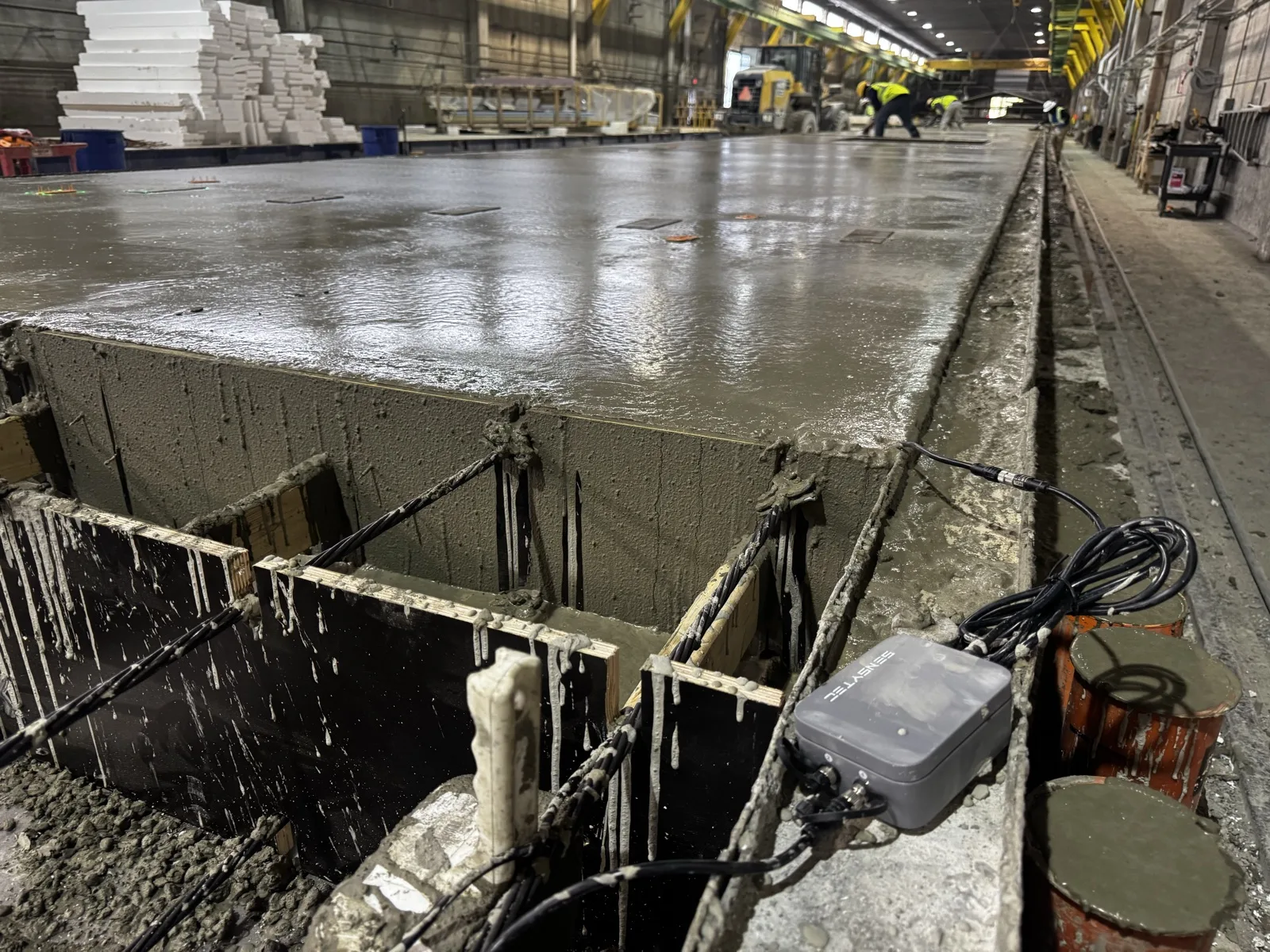
A wireless sensor in the pour replaces guesswork with continuous in-place data.
How Real-Time Monitoring Closes the Hot-Weather Loop
Three things make wireless concrete sensors the right tool for hot-weather work:
- Temperature history. Regularly logged readings help the team identify peaks and compare core and surface conditions at the instrumented locations.
- Threshold alerts. Set warning levels and response procedures from the approved thermal plan. Alerts support action but do not themselves cool the concrete or prevent cracking.
- QC documentation. Export temperature records for the project team. Review the measurement locations, calibration and required records before using an export as compliance evidence.
The ASTM C1074 maturity method estimates strength using a relationship established for the mix and its temperature history. It requires supplemental strength evidence. A sensor reading alone does not establish exact design strength, authorize release or guarantee a shorter schedule.
A Practical Hot-Weather Pour Checklist
- Day before. Review forecast temperature, wind and humidity; calculate evaporation and prepare surface protection under the approved hot-weather plan.
- Mix at the plant. Verify chilled water or ice charge. Confirm SCM substitution and admixture dose for the day's conditions.
- Site prep. Wet subgrade and forms before placement to reduce moisture loss from below. Position windbreaks, fogging equipment, and curing blankets.
- At discharge. Measure fresh-concrete temperature and compare it with the accepted project limit. Install in-place sensors according to the monitoring plan; they do not replace the required discharge-temperature check.
- During finishing. Apply evaporation retarder between passes. Fog upwind. Protect from direct sun.
- After finishing. Start the specified curing treatment at the appropriate stage and protect the surface against moisture loss. Maintain it for the duration or verified termination criterion required by the project.
- Through the cure. Review temperature histories and act on the approved thermal plan. Obtain the required test results and approval before removing forms or ending protection.
- Documentation. Export the temperature and strength record from the sensor platform for the QC binder.
Frequently Asked Questions
What is hot-weather concrete?
Hot-weather concreting involves conditions such as high temperature, low humidity, wind and sun that can accelerate setting and moisture loss. Assess the combination of conditions and the approved project plan rather than using one air-temperature cutoff.
What is the maximum concrete temperature for placement?
ACI guidance identifies a 95 °F (35 °C) maximum at discharge under ACI 301-20 and ACI 305.1-14 for general construction, excluding mass concrete. A higher limit requires mixture qualification and architect/engineer acceptance before placement. Follow any stricter project limit.
What causes plastic shrinkage cracks in hot weather?
Plastic shrinkage cracks can develop when surface water evaporates faster than bleed water replaces it. Temperature, humidity, wind, sun and mixture behavior affect the risk. Plan surface protection using the project requirements and current conditions; a temperature sensor alone cannot assess surface evaporation.
How do wireless concrete sensors help in hot weather?
Embedded sensors record in-place temperature at selected locations and provide histories and alerts for review. They support the team's response to the thermal plan, but do not themselves prevent cracks, replace fresh-concrete acceptance checks or establish exact compressive strength.
What admixtures and mix changes help with hot-weather pours?
Common adjustments include retarding admixtures to slow setting, water-reducing admixtures to maintain workability without adding water, supplementary cementitious materials like fly ash or slag to lower heat of hydration, and ice or chilled mix water to reduce concrete temperature at the plant. The right combination depends on the mix, the structural element, and the verified in-place temperature.
What is the ACI 305 evaporation rate nomograph?
The ACI 305 nomograph estimates surface-water evaporation from air temperature, concrete temperature, relative humidity and wind speed. Use it with the project's specified action criteria and the mixture's bleed characteristics to plan protection; it is not a guarantee that cracking will or will not occur.
How long should concrete cure in hot weather?
Follow the project's curing method, duration and permitted termination criteria. Required protection depends on the mix, conditions and performance requirements. Maturity estimates can inform an approved procedure, but reaching an estimated strength does not automatically authorize ending curing.
Plan monitoring for your next pour
Pouring through summer? Let's monitor it.
Review in-place temperature, calibrated strength estimates and the records needed for your project.
Talk to an Expert