Mass concrete pour monitoring is the continuous measurement of in-place temperature in pours large enough to require thermal control (typically thicker than 36 inches), used to enforce the ACI 207 limits of 158°F peak temperature and 35°F core-to-surface differential and prevent delayed ettringite formation (DEF) and thermal cracking.
- ACI 207 governs mass concrete: any pour large enough that hydration heat must be actively managed (typically > 36 in thick)
- Peak in-place temperature must stay below 158°F (70°C) to prevent delayed ettringite formation (DEF)
- Core-to-surface temperature differential must stay below 35°F (19°C) to prevent thermal cracking
- Common controls: chilled mix water, fly ash / slag (lower heat of hydration), post-cooling pipes, surface insulation, lower placement temp
- Continuous wireless sensors at multiple depths verify both limits in real time and document compliance with the thermal control plan
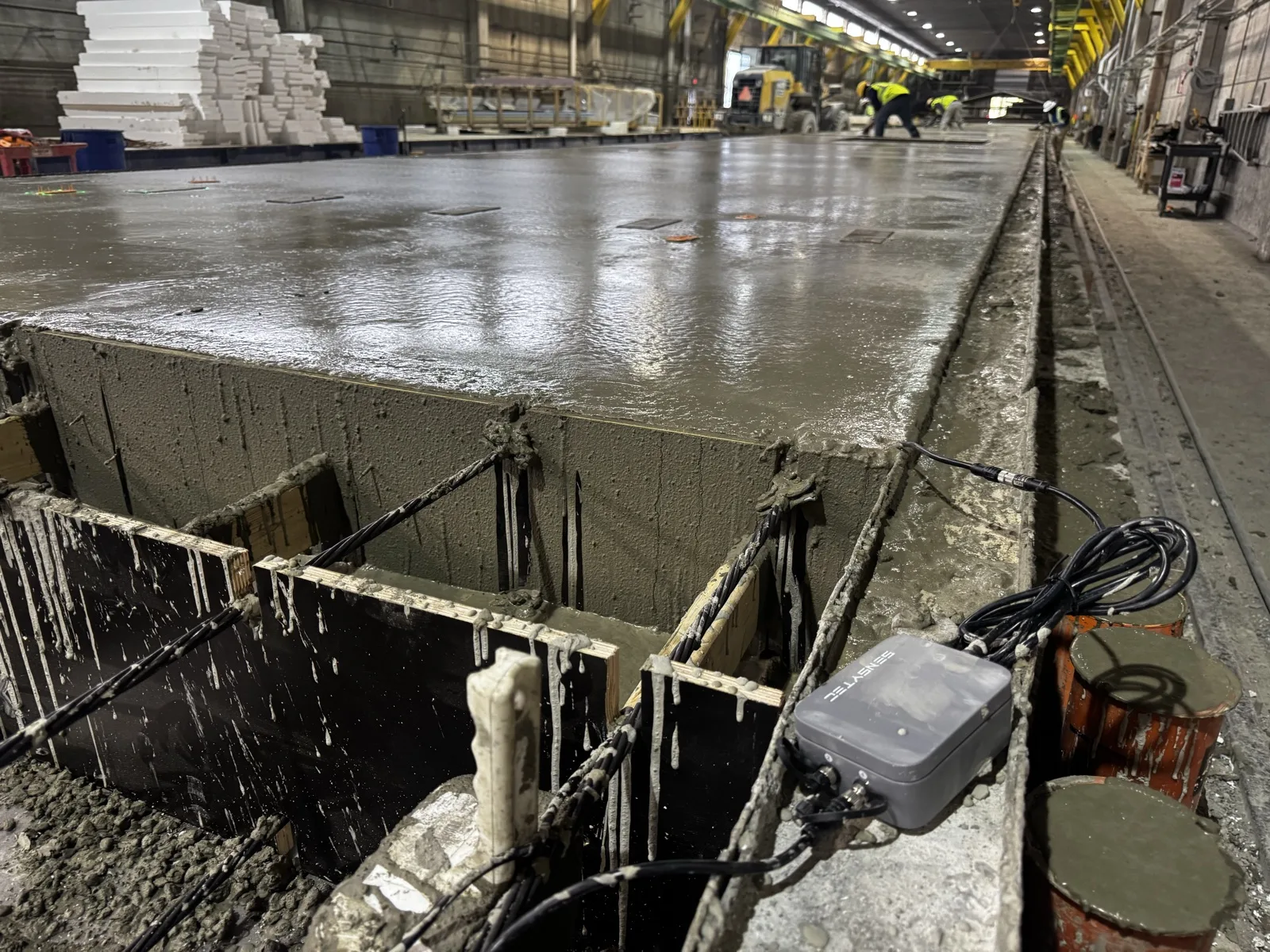
Wireless sensors embedded at multiple depths in a mass pour capture core, mid-depth, and surface temperatures continuously.
What Counts as Mass Concrete
ACI 207 defines mass concrete as any volume of concrete with dimensions large enough to require measures to cope with the heat generated from cement hydration and accompanying volume change. In practice that means:
- Foundations and mat slabs thicker than about 36 inches
- Drilled shafts and caissons with diameters above 36 inches
- Bridge piers, abutments, and pile caps
- Columns and walls thicker than 36 inches
- Dam structures, retaining walls, and tunnel linings
- Industrial foundations for power, oil & gas, and heavy equipment
Some specifications trigger mass concrete provisions at lesser thicknesses (24 inches or even 18 inches for high-cement-content mixes), so always check the project spec.
Why Mass Concrete Is Different
Cement hydration is exothermic. Each pound of cement releases roughly 90 BTU of heat as it reacts with water. In a thin slab the heat dissipates fast and the in-place temperature stays close to ambient. In a mass pour the heat has nowhere to go — the core is insulated by the concrete around it — so temperature inside the pour climbs steadily for the first 24 to 72 hours, peaks, and then cools slowly over days or weeks.
Two specific failures arise from this thermal behavior:
1. Thermal cracking from core-to-surface differential
As the core climbs to peak temperature, the surface is losing heat to the air or to the formwork. The hot core wants to expand but the cooler surface (which has already stiffened) restrains it. Tensile stress builds in the surface. When the differential exceeds the tensile capacity of the surface concrete, cracks open — usually parallel and several feet long, sometimes propagating deep into the structure. ACI 207 limits the differential to 35°F as a working rule.
2. Delayed ettringite formation (DEF)
When in-place concrete crosses about 158°F at early age, the chemistry that normally forms ettringite during the first hours of hydration gets disrupted. Years later, when the concrete is exposed to moisture, ettringite re-forms expansively in the hardened paste. The expansion cracks the concrete from the inside out. The damage shows up 5 to 30 years after placement and is essentially un-repairable. The only prevention is to keep the early-age core temperature below 158°F.
The Numbers That Matter
| Parameter | Standard Limit | Why |
|---|---|---|
| Peak in-place temperature | ≤ 158°F (70°C) | Prevents DEF |
| Core-to-surface differential | ≤ 35°F (19°C) | Prevents thermal cracking |
| Placed concrete temperature | ≤ 85°F | Lower starting temp = lower peak |
| Cooldown rate | ≤ 20°F per 24 hours | Prevents thermal shock at protection removal |
All four limits typically appear in the project Thermal Control Plan, which contractors must submit to the engineer of record before the pour. Continuous in-place temperature data is the evidence that the plan was actually executed.
Controlling Mass Concrete Temperature
Lower the placed temperature
Every 10°F drop in placement temperature roughly translates to a 10°F drop in peak temperature. Tools: chilled mix water, ice as a partial water replacement, shaded aggregate stockpiles, liquid nitrogen injection in extreme cases. Pours scheduled at night or early morning naturally start cooler.
Modify the mix to lower heat of hydration
Replace 30–50% of cement with fly ash, ground granulated blast furnace slag (GGBFS), or other pozzolans. SCMs hydrate slower and release less total heat. The trade-off is slower early strength gain — usually acceptable for mass pours where loading is delayed.
Embed cooling pipes
For very large pours (dam sections, deep mat slabs over 5 feet), HDPE or steel pipes are pre-installed in the formwork. Chilled water circulates through them during the cure to draw heat out of the core. Pipes are grouted shut after the cooling phase.
Insulate the surface
Counterintuitive but standard: insulating the surface keeps the surface warm so the differential to the core stays small. Insulated curing blankets, foam board on forms, or sand layers are common. The goal is not to limit peak temperature but to limit the difference between core and surface.
Verify with continuous in-place data
All of the above are inputs to the cure. The output that matters is the actual core and surface temperatures, measured continuously, with alerts before either limit is exceeded. This is what wireless sensors provide.
Sensor Placement for Mass Pours
A typical mass pour instrumentation plan uses three to six sensors per pour:
- Center of mass: the geometric center of the pour, where peak temperature will be highest. This sensor enforces the 158°F peak limit.
- Near the surface or formed face: the coolest point, used with the center sensor to compute the core-to-surface differential. Place 2–3 inches below the finished surface.
- Mid-depth: an intermediate point that fills out the temperature profile, useful for QC documentation and for calibrating cooldown rates.
- Corner sensors: for very large pours, the corners lose heat fastest in two directions. A corner sensor near the surface helps identify hot spots that the center-and-surface pair would miss.
Sensytec helps lay out the placement based on the geometry of your specific pour and the thermal control plan. The real-time monitoring guide covers the broader sensor architecture.
Mass Pour Day-of Checklist
- Plan submitted. Thermal Control Plan approved by EOR. Sensor layout, threshold limits, and protection method documented.
- Sensors installed. Tied to rebar at planned locations and depths before placement begins. Verified transmitting to the gateway.
- Placement temp verified. Concrete-as-placed temperature measured at the truck and confirmed below the spec limit.
- Live monitoring active. Crews and EOR can see the temperature curve on phone or laptop in real time.
- Threshold alerts armed. Push or email notifications fire if the core approaches 158°F or the differential approaches 35°F.
- Surface protection in place. Insulation blankets, sand layer, or other surface treatment applied per plan.
- Cooling system on (if applicable). If embedded cooling pipes are part of the plan, confirm flow and inlet/outlet temperatures.
- Cooldown phase managed. Insulation removal sequenced so the cooldown rate stays within the spec limit (typically 20°F per 24 hours).
- QC export. When the cure period ends, export the temperature record (PDF / CSV) for the project file and EOR closeout.
Frequently Asked Questions
What is mass concrete?
ACI 207 defines mass concrete as any volume of concrete with dimensions large enough to require measures to cope with the heat generated from cement hydration and accompanying volume change. In practice this means foundations, mat slabs, columns, and walls thicker than about 36 inches.
What is the maximum core temperature for mass concrete?
Industry standard limits peak in-place temperature to 158°F (70°C) to prevent delayed ettringite formation, a long-term durability problem where late expansive reactions crack the concrete. Some agencies allow up to 165°F with specific mix qualifications.
What is the core-to-surface differential rule?
As the core of a mass pour heats up faster than the cooling surface, tensile stress builds in the surface. ACI 207 typically caps the core-to-surface temperature differential at 35°F (19°C) to prevent thermal cracking.
How is mass concrete temperature controlled?
Common control methods include lowering the placed concrete temperature with chilled water or ice at the plant, replacing a portion of cement with fly ash or slag to reduce heat of hydration, post-cooling with embedded cooling pipes, insulating the surface, and pre-cooling aggregates.
Why are wireless sensors important for mass concrete?
Mass concrete temperature evolves over days, not hours. Spot checks miss the peak. Wireless sensors capture continuous in-place temperature at multiple depths simultaneously, calculate the core-to-surface differential in real time, and send threshold alerts before either the 158°F peak or the 35°F differential is exceeded.
Where do I place sensors in a mass pour?
At minimum, one sensor at the geometric center (the hottest point) and one near the surface (the coolest point). For larger pours, additional sensors at intermediate depths and at corners provide a fuller picture.
What is delayed ettringite formation (DEF) and how is it prevented?
DEF is a long-term durability failure where ettringite re-forms expansively in concrete that experienced very high early-age temperatures (typically above 158°F). The expansion cracks the concrete years after placement. Prevention is to keep the in-place core temperature below 158°F throughout the cure.
From the thermal plan to the project record
Pouring mass concrete? Let's monitor it right.
Continuous in-place temperature, automatic threshold alerts, and exportable thermal control plan documentation.
Talk to an Expert