- A maturity model calibrated with the ASTM C1074 equivalent-age method for the plant’s real 250 kg/cm² mix, validated against four break sets (twelve cubes) from the same pour
- Prediction error stayed under 1.3% against the actual cube breaks, averaging 0.7%
- Release reached 7.5 hours after the 12:01 p.m. pour, with the wall reading 370 kg/cm² — 148% of release strength — the next morning
- Two independent physical methods, maturity and electrical resistivity, cross-checking each other throughout
- Estimated annual saving of $259,650 USD with payback in about 2.2 months
The Precast Problem
Release decisions get made against the clock: conservative cure times and plenty of cube breaks to “be safe.” That pins beds, consumes lab hours and caps production. The goal of this July 8, 2026 demonstration was direct: calibrate a maturity-based strength model for the plant’s real 250 kg/cm² mix (roughly 3,560 psi), verify it against real breaks from the same pour, and monitor strength inside the element in real time through release.
SensyRoc sensors went inside a companion cube and inside the wall element, both cured in the same outdoor conditions. Temperature and resistivity logging ran continuously from the 12:01 p.m. pour, and cubes were broken on a set schedule to trace the strength-maturity relationship right where the release window sits.
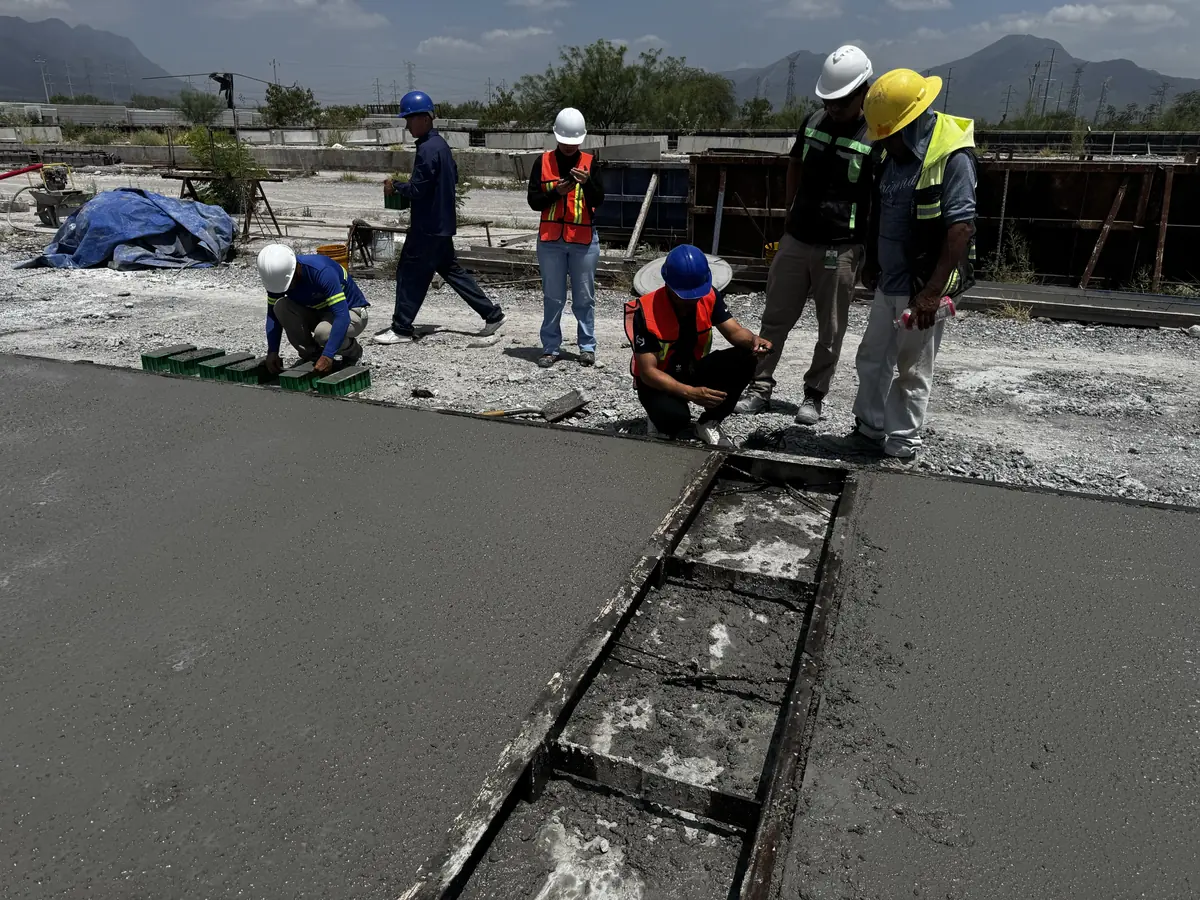
Finishing a precast wall panel at Concremex, in Monterrey.
Prediction vs. Actual Breaks
| Break | Maturity (°C·d) | Predicted (MPa) | Measured (MPa) | Error |
|---|---|---|---|---|
| 1 | 0.9723 | 21.71 | 21.67 | +0.2% |
| 2 | 1.2083 | 25.25 | 25.43 | −0.7% |
| 3 | 1.3926 | 27.57 | 27.23 | +1.2% |
| 4 | 1.4643 | 28.39 | 28.60 | −0.7% |
The four break sets span the 6 to 11 hour window around release. Average error 0.7% (1.2% maximum). Maturity is equivalent age computed by the platform on the companion cube; strength from the calibrated curve S = 22.168 + 16.32·ln(M), R² = 0.99.
The release
The element reached its 250 kg/cm² release strength around 7:31 p.m., 7.5 hours after the pour. The wall kept gaining and read 370 kg/cm² (roughly 5,260 psi, 36.3 MPa) the next morning — 148% of release strength — with the system still monitoring live from the app and dashboard.
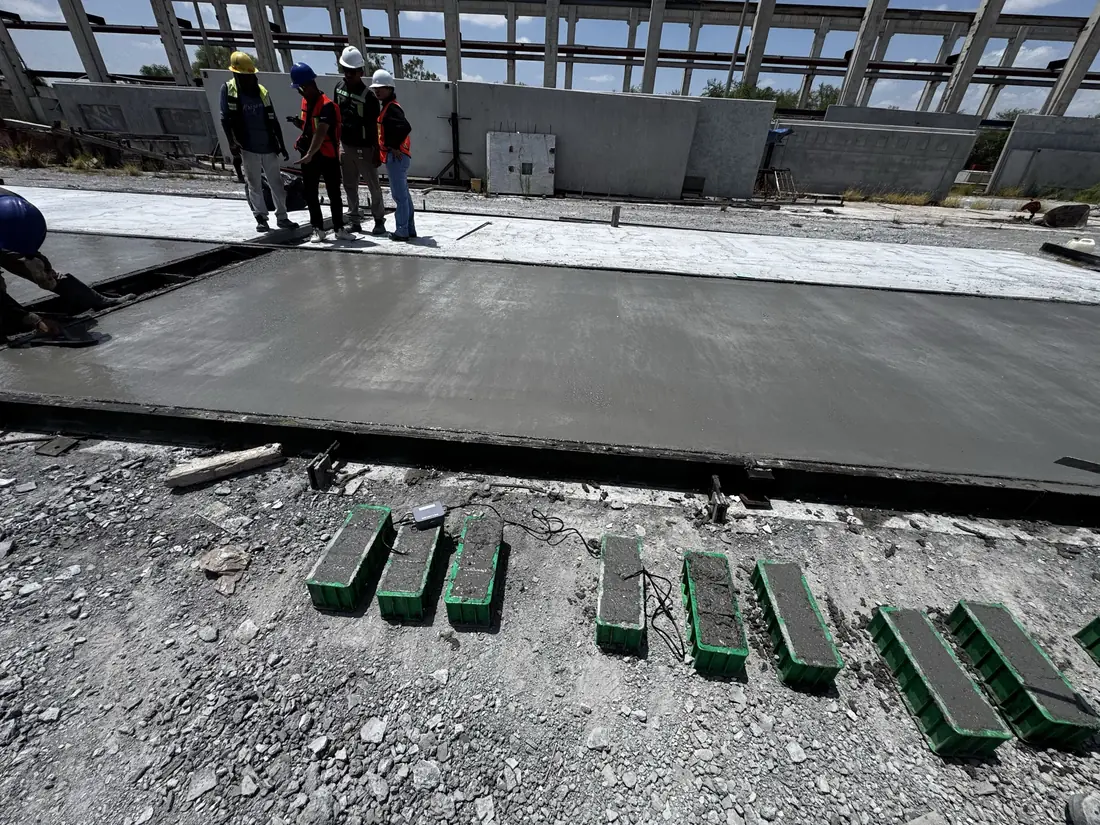
Companion cubes and the logger, cured in the same outdoor conditions as the element.
Dual Verification: Maturity and Resistivity
The calibration followed the ASTM C1074 equivalent-age method; in Mexico, the maturity method is covered by NMX-C-579-ONNCCE. In parallel, the system measured electrical resistivity per ASTM C1876, whose applicable Mexican norm is NMX-C-514-ONNCCE. These are two independent physical properties converging on the same strength: if one drifts, the other catches it. For a plant lab, that means live strength with cross-checked backup, fewer verification breaks, and QC documentation generated automatically, audit-ready. The two physics also explain why the cube, not the element, anchors the calibration: the massive wall holds heat and over-reads maturity by up to 15%, so calibrating on the companion cube keeps the release call on the safe side. In this pour the cube peaked at 57.7°C and the wall at 57.1°C, but the wall held near 35°C overnight while the cube fell to about 27°C, and resistivity tracked the maturity strength within about 2% throughout.
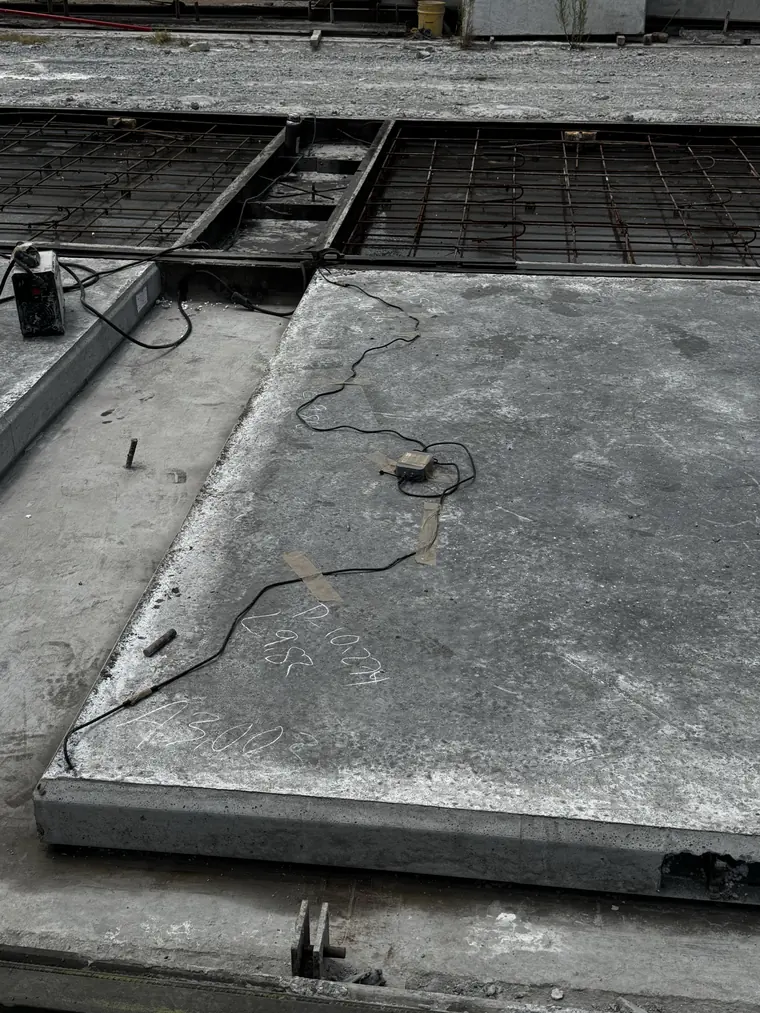
A Sensytec sensor reading temperature and resistivity from a cured panel at Concremex.
What It Means for the Plant
Releasing on data instead of the clock turns every faster rotation into a bed available sooner: more pieces from the same beds, without expanding the plant or adding shifts. The estimated annual saving for this operation is $259,650 USD, with payback in about 2.2 months, combining the extra bed cycles, up to 50% fewer verification breaks, fewer rejected elements, and a lab freed from manual documentation.
Frequently Asked Questions
How accurate was the model against the actual breaks?
The calibrated model predicted every cube break within 1.3%, averaging 0.7% error across the four break sets (twelve cubes) from the same pour. Electrical resistivity cross-checked the maturity result within about 2%.
Which standards back the method?
The calibration used the ASTM C1074 equivalent-age method; in Mexico the maturity method is covered by NMX-C-579-ONNCCE. Electrical resistivity was measured per ASTM C1876; the applicable Mexican norm is NMX-C-514-ONNCCE.
How does the system avoid depending on a single measurement method?
It measures two independent physical properties: temperature-based maturity and electrical resistivity. Both converge on the same strength; if one drifts, the other catches it. That cross-verification is built into the platform.
What is the estimated return for the plant?
The estimated annual saving for the plant is $259,650 USD, with payback in about 2.2 months. It comes from extra bed cycles unlocked by earlier release, up to 50% fewer verification breaks, fewer rejected elements, and automatic QC documentation.
Related Case Studies
Prove It on Your Own Mix
We calibrate and validate the model at your plant, with your mix and your cubes. One pour is enough to see it.
Request a Demo